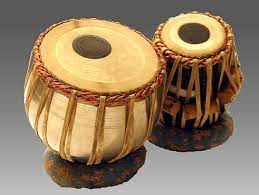
Tabla is the drum set most commonly played in North Indian music. It is the most commonly used instrument for dance as well as vocal and instrumental music. Its main function is to maintain a prosodic cycle whose composition is fixed. Although the tabla is essentially an accompaniment instrument, tabla players are also soloists themselves, with a vast repertoire of elaborate compositions, many of which have been passed down orally from generation to generation.
Tabla’s name comes from the Arabic origin tabla. The general meaning of the term tabla is an instrument with a flat, upward facing surface. Scholars believe that the term tabla in English was borrowed from the term tabla. Others believe that the term tabla was originally borrowed from Latin tabla rather than Arabic.
Tabla was originally used to refer to an oval or hemispherical musical instrument with skin stretched over an opening, also called a timpani. These were essentially martial arts drums that accompanied Muslim military expeditions. These timpani, though made of metal, are derived from primitive man drums. Later they became round like eggs. This may have been an adaptation to facilitate carrying on horseback or camel. Slowly, general used as a prefix for all types of percussion instruments common in the Middle East, regardless of their form, such as tabl baladi, tabl turki, tabl nakkara, tabl mighri, tabl al-gawig has become a common term.